Patagonia
Patagonia can move from pale crystalline fields to dark mineral masses and warm translucent passages within one slab. The exact slabs, finish, cut plan, and lighting design matter as much as the material name.
Historical photographs illustrate the material; they do not establish current inventory. Current slabs, availability and pricing are confirmed for your project.
What is Patagonia stone?
Patagonia is a trade name used across several visually related selections. Antolini catalogs Patagonia Original as Cristallo / Natural Quartz. Other suppliers may use different labels or classifications, so confirm the technical data for the exact lot under consideration.
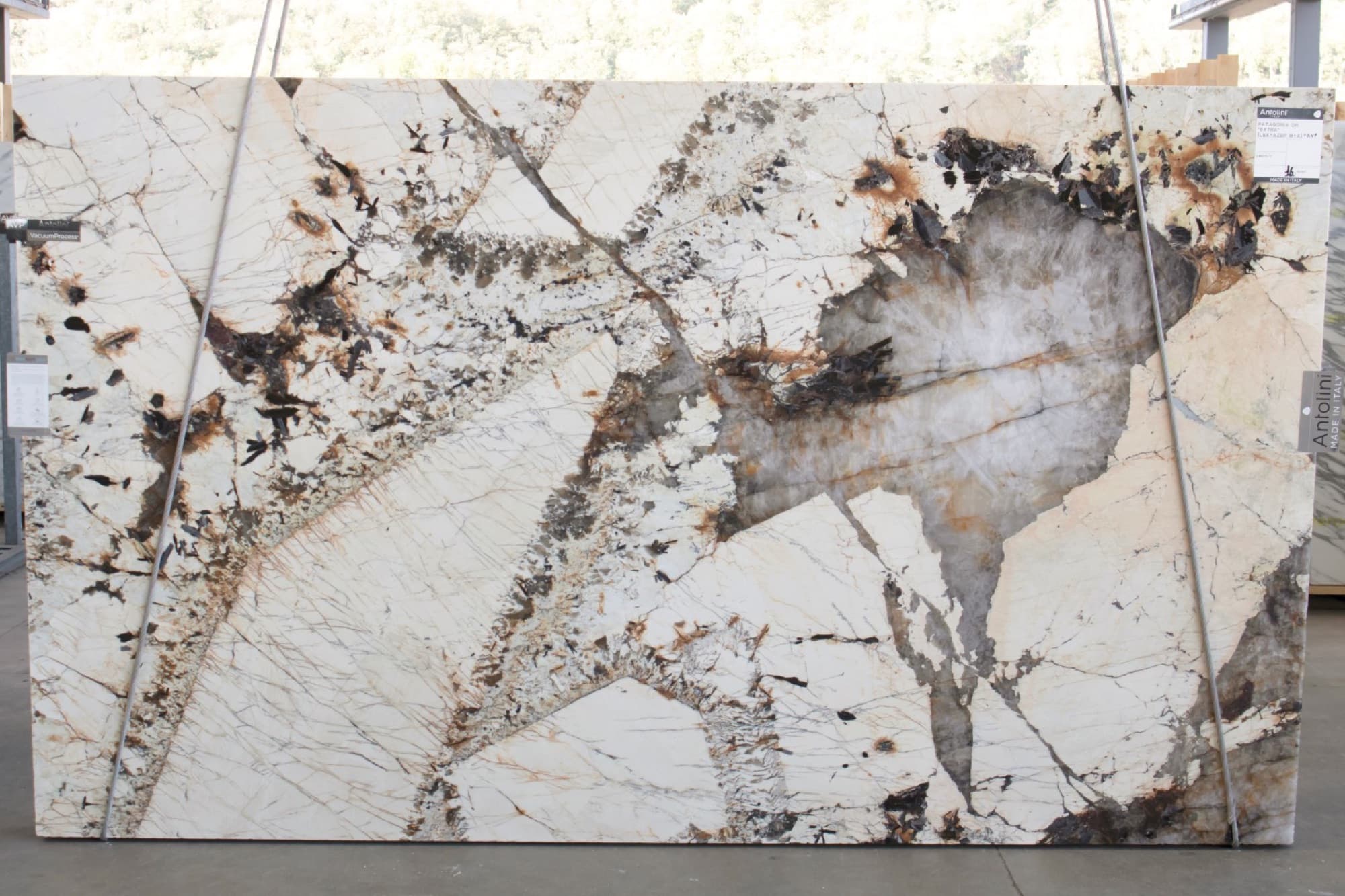
Its appeal is the range inside one piece. Creamy matrix, dark mineral areas, and translucent quartz zones can be distributed very differently from slab to slab. For a focal wall or island, selecting individual slabs is as important as choosing the material name.
Polished, matte, leathered, and sculptural texture
A polished face creates sharp reflections and stronger apparent color contrast. Matte or leathered finishes change how the stone catches light and can make its mineral structure feel quieter or more tactile. Antolini lists Lux, Matt, and Lether among finishes for Patagonia Original; availability depends on the exact selection and lot.
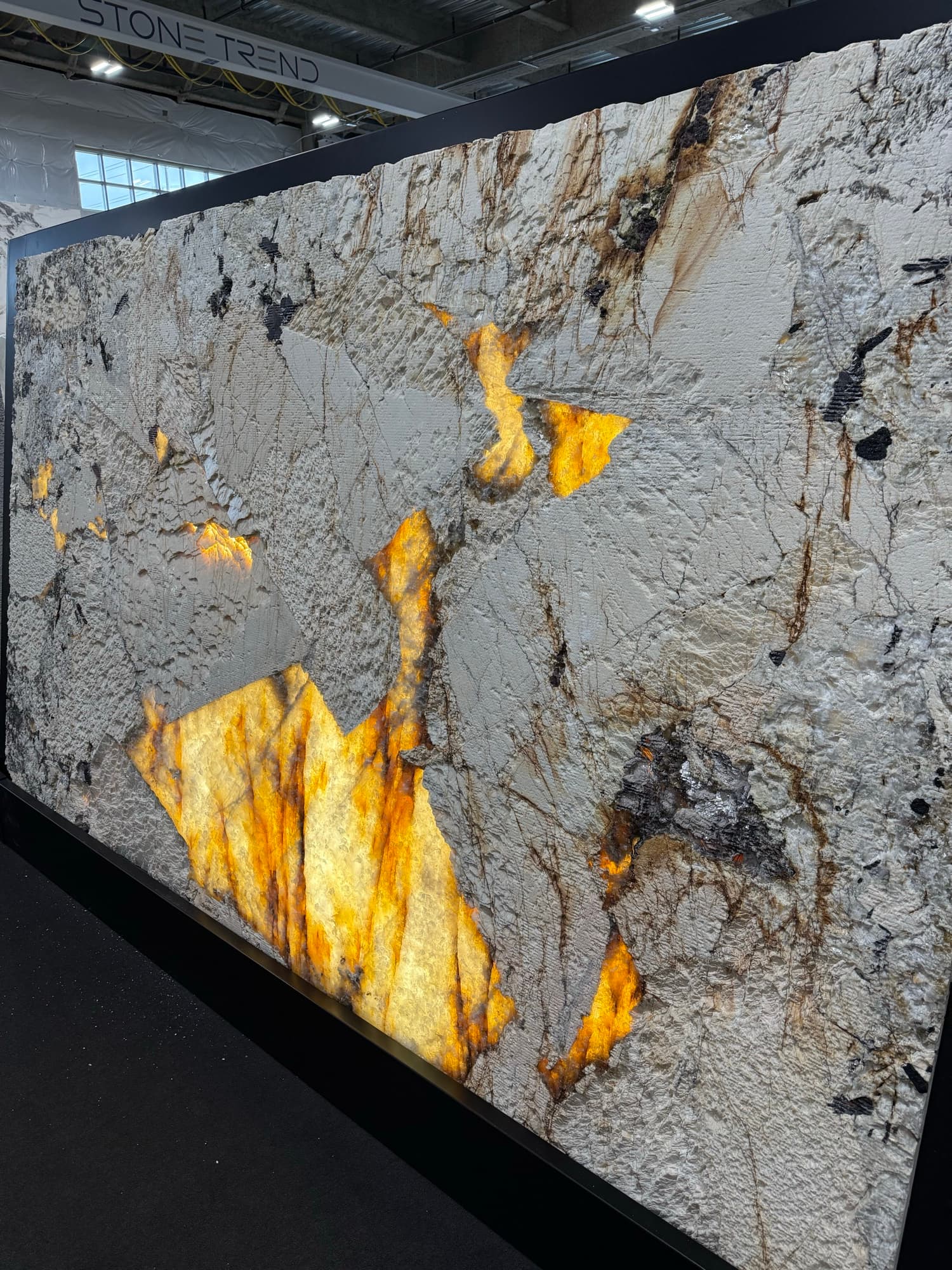
The Seattle photograph shows much deeper relief than a conventional polish. This sculptural treatment gives the stone a different character. Ask to see the proposed finish on the material being considered for your project.
Texture affects fabrication. A fabricator should review how the relief meets edges, seams, sinks, and adjoining flat surfaces. Mock up a representative area to see both high and low parts of the finish under the project's lighting.
Backlighting is a design and fabrication decision
In the Seattle photograph, amber zones illuminate while much of the surrounding stone remains opaque. This unevenness gives the composition depth. A single photograph cannot predict the light behavior of an entire slab.
Before pricing a backlit wall, bar, or feature panel, test the exact proposed slab with the intended light source, diffusion, support, and final thickness. Plan access to the lighting system and consider how the surface reads when the lights are off.
How to select slabs for a project
Start with the overall dimensions and visible faces. Request current photographs of every candidate slab, with its dimensions, thickness, finish, and block or lot identification. Put those images in installation order before choosing seams or a bookmatch.
For an island, decide which part of the slab becomes the top, waterfall, and return. For a wall, account for openings, corners, edge exposure, and lighting. The fabricator should confirm usable yield and any reinforcement required by the actual material.
What determines the price?
A meaningful Patagonia quote depends on the exact lot, visual composition, thickness, finish, slab size, matching requirement, fabrication yield, freight, and any lighting assembly. A sculpted, backlit installation is a different scope from an uncut polished slab.
Send the sizes, quantity, location, schedule, and finish direction so we can price options for the actual scope.
Selection considerations
- The photograph shows large changes in color and pattern across a single slab. A small sample would hide much of that variation.
- A focal wall or island should be composed from photographs of the actual available slabs, in sequence, before cutting begins.
- If translucency or backlighting is part of the design, test the proposed slabs and lighting assembly together rather than assuming the whole surface behaves uniformly.
Questions before sourcing
- How many pieces must read as one composition?
- What dimensions and usable yield are required?
- Which zones should become the visual focus?
- Is backlighting intended, and where?
What we verify before a quote
- Current photographs, dimensions, thickness, and lot identification for each slab
- Physical finish sample and fabrication feasibility review
- Scaled layout showing seams, returns, edges, and usable yield
- A mockup using the actual slab if backlighting is planned
- Written material, freight, fabrication, and lighting quote
Common questions
Can you source Patagonia for my project?
Yes. Share the size, location, timing, and visual direction, and we can present current slab options for your project.
Can every Patagonia slab be backlit?
No. Translucency varies within a slab and between lots. Test the intended piece and lighting assembly together.
Is Patagonia marble or quartzite?
Trade names vary. Antolini classifies Patagonia Original as Cristallo / Natural Quartz. Ask the current supplier for the technical classification of the exact selection proposed.
From selection to an executable project
Looking for Patagonia or a related material?
Send a reference image, project location, approximate sizes, quantity, timing, and finish direction. Mark can investigate current slabs and explain what needs to be verified before any purchase.
Ask Mark to source PatagoniaAll material studiesTechnical references